Project Context and Publication Boundary
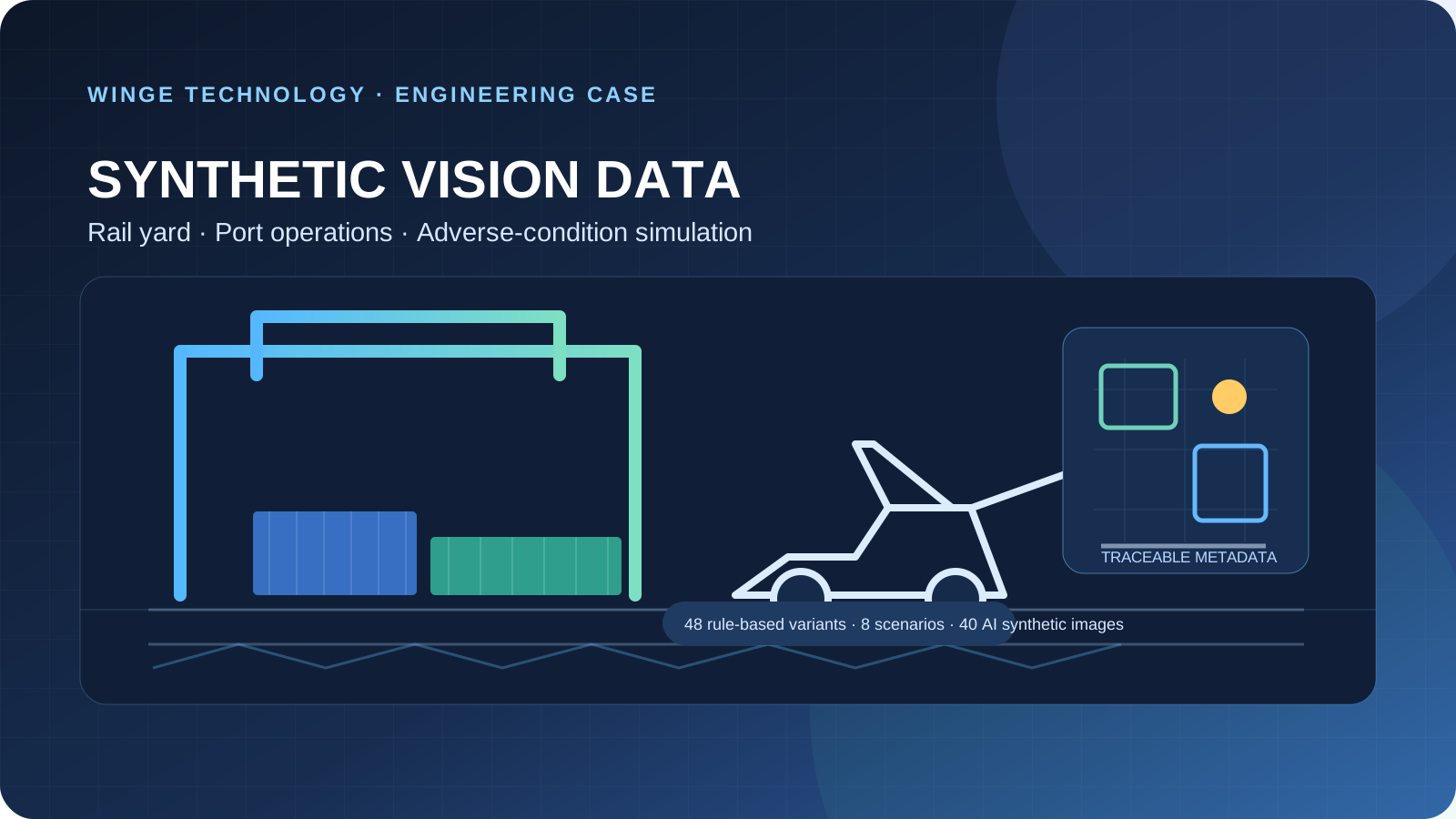
This project addressed vision-data simulation for rail freight yards and port operations. The public case removes the customer, location and asset identifiers and reports only quantities, processing methods, quality checks and limits that can be verified from the delivery files. The input included gantry and worksite images plus a class-name file with forklift, cone, bollard and person. It did not contain bounding-box or segmentation annotations suitable for supervised learning.
The batch is an image-level data generation and organization delivery. It is not a completed object-detection training project or field algorithm acceptance. No bounding boxes, masks or keypoints were delivered, and no frozen truth set was available from which a performance improvement could be claimed.
Engineering Objective
The objective was to create reproducible visual variants for night, rain, fog, backlight, motion blur, occlusion and surveillance compression, then establish a structured base for later annotation, training and acceptance. The work also exercised file organization, metadata mapping and repeatable QA so that the scenario and acceptance vocabulary could be reviewed before additional site capture.
Two Independent Data Paths
The rule-based path generated eight environment or imaging-degradation variants from screened operational images. Script, output name, scenario and metadata remain traceable. The AI-synthetic path produced scenes for forklifts, lifting equipment, containers and safety cones to support concept coverage and data planning. Images from the second path are managed as synthetic material and are not presented as records of a real facility.
Rule-Based Simulation Dataset
The dataset contains 48 JPG images at 1280×720, organized into eight scenarios with six images per scenario. A clear-day baseline is retained alongside low light, local illumination, rain streaks, haze, distance contrast loss, sunset color shift, highlight pressure, motion degradation, foreground obstruction and low-bitrate compression.
| Scenario | Images | Intended use |
|---|---|---|
| Clear-day baseline | 6 | Normal-light reference and pipeline regression |
| Night yard | 6 | Low light, local sources and noise |
| Rain on camera | 6 | Rain streaks and reduced contrast |
| Fog and haze | 6 | Distance-dependent contrast loss |
| Sunset backlight | 6 | Color shift, highlights and compressed shadows |
| Motion blur | 6 | Camera or target motion degradation |
| Foreground occlusion | 6 | Partial obstruction of the field of view |
| Surveillance compression | 6 | Low-bitrate and block-compression effects |
These images can exercise a data pipeline, annotation workflow and an algorithm's sensitivity to visual changes. They do not replace capture at the target facility and cannot by themselves establish performance in real rain, fog or night operation.
AI-Synthetic Class Dataset
The AI-synthetic set contains 40 RGB images at 1672×941, with ten images in each of four classes. The content covers forklifts in port, yard, warehouse or construction contexts; gantry or related lifting structures; container stacks and transfer areas; and safety-isolation elements. All 40 files have different SHA-256 values. File-level uniqueness does not establish adequate semantic diversity, unbiased classes or compliance with a particular site's geometry and safety rules.
| Class | Images | Coverage |
|---|---|---|
| Forklift | 10 | Operational vehicles in yards, warehouses and construction areas |
| Lifting equipment | 10 | Gantry, bridge or comparable engineered lifting structures |
| Container | 10 | Stacks, transfer zones and transport scenes |
| Safety cone | 10 | Work-zone separation and traffic guidance |
Foreground Pose and Composition Samples
Three additional samples demonstrate foreground pose and background adaptation in a road-edge setting, a construction area and a factory environment. They cover tilt and yaw variations to check whether synthesis prompts and composition constraints can express a requested pose. They are not precision pose-angle measurements and do not establish detection performance for real equipment.
Metadata and Reproducibility
The rule-based path records the source clue, output file, scenario, class hint and processing entry. Its 48 metadata rows map one-to-one to 48 images. The Python generator is retained with the delivery and can reproduce the outputs when the same inputs, dependencies and parameters are used. A production pipeline should additionally record source authorization and capture batch, script commit, dependency versions, random seed, transform parameters, annotation-specification version, reviewers and frozen dataset hashes.
Measured Quality Checks
All 48 rule-based images opened successfully and matched 48 metadata rows; every scenario contains six images. The review reported zero unknown rows, zero retained external ordinary-road source rows, zero low-information candidates and zero near-duplicate pairs under the implemented threshold. Brightness minimum, median and maximum were 39.4, 94.55 and 137.5. Grayscale standard deviation was 15.5, 37.3 and 62.6. Those values describe exposure and contrast coverage; they are not image-quality scores.
| Check | Measured result | Meaning |
|---|---|---|
| Images / metadata rows | 48 / 48 | Count matched; all files readable |
| Scenario distribution | 8 scenarios × 6 | Matches the generation plan |
| Unknown / external-source rows | 0 / 0 | Hints parsed and ordinary-road sources filtered |
| Low-information / near-duplicate reports | 0 / 0 | No issue reported by the current rules |
| AI-synthetic files | 40; 10 per class | All 1672×941 RGB with distinct file hashes |
Delivered Artifacts
The delivery includes rule-based simulated images, AI-synthetic images, metadata, preview contact sheets, the QA summary, the reproducible Python script and a 19-page customer review document. The document uses 16 selected large examples for visual review. It does not replace the complete image folders or machine-readable metadata.
Applicable Workflows
The method supports requirement clarification, adverse-condition enumeration, annotation-specification rehearsal, data-pipeline regression, class-coverage discussion and robustness experiment design. For ports, rail yards, warehouses, construction sites and fixed surveillance, a small synthetic batch can help freeze visual conditions before the team commits to site recapture, annotation and model iterations.
Limits, Risks and Acceptance Boundary
- The batch has no boxes, masks or keypoints and should not be called a complete detection training dataset.
- AI-synthetic images may contain structural, scale, perspective or safety-logic errors and require human review.
- Rule-based degradation is a visual approximation, not a physical model of weather, lens contamination or a specific encoder.
- The available evidence covers files and distributions, not customer truth data, detection accuracy, long-duration stability or production rollout.
- Authorization, privacy and facility confidentiality must be addressed in the applicable contract and data-governance process.
Before formal training, freeze class definitions, label format, minimum target size, occlusion rules and hard-case scope. Recommended acceptance includes random sampling, double-review agreement, cross-split near-duplicate isolation, class and scenario distribution reports, and Precision, Recall, F1 or task-specific metrics on an independent real-world test set.
Frequently Asked Questions
Can these images directly train an object detector?
Not as a labeled detection dataset. Bounding boxes or segmentation masks must first be created, reviewed and validated in the format required by the training framework.
Were all 48 rule-based images produced by one repeatable process?
Yes. The delivery retains the Python generator, output naming and metadata. Reproduction still requires the same source images, dependencies, parameters and environment.
Can AI-synthetic images replace real facility data?
No. They can extend concept coverage, explore scene combinations and rehearse an annotation specification. Final testing and acceptance need authorized real data that matches the deployment environment.
What does the current QA establish?
It establishes readability, count-to-metadata consistency, the planned scenario distribution and absence of exact file duplicates or defined low-information exceptions. It does not establish semantic correctness, label accuracy or model performance.
What inputs are needed for the next phase?
The next phase needs class definitions, representative site captures, size and occlusion rules, annotation format, training framework, deployment-camera parameters, authorization boundaries and measurable acceptance targets. Safety-related use also needs false-alarm, missed-detection and human-review procedures.


 Online

 Phone
Phone

 WeChat



 Top
Top