Pinned build and boot baseline
Pinned OpenHarmony-v6.1-Release, the RK3588 AArch64 target, Linux 5.10.210, the EVB1 LP4 V10 DTB, and SHA-256 values for critical boot assets.
OPENHARMONY · RK3588 · STAGE-0
Using OpenHarmony-v6.1-Release, Winge completed a minimum headless Stage-0 run on the specified RK3588 board and established a traceable build, media-write, boot, logging, and evaluation workflow.
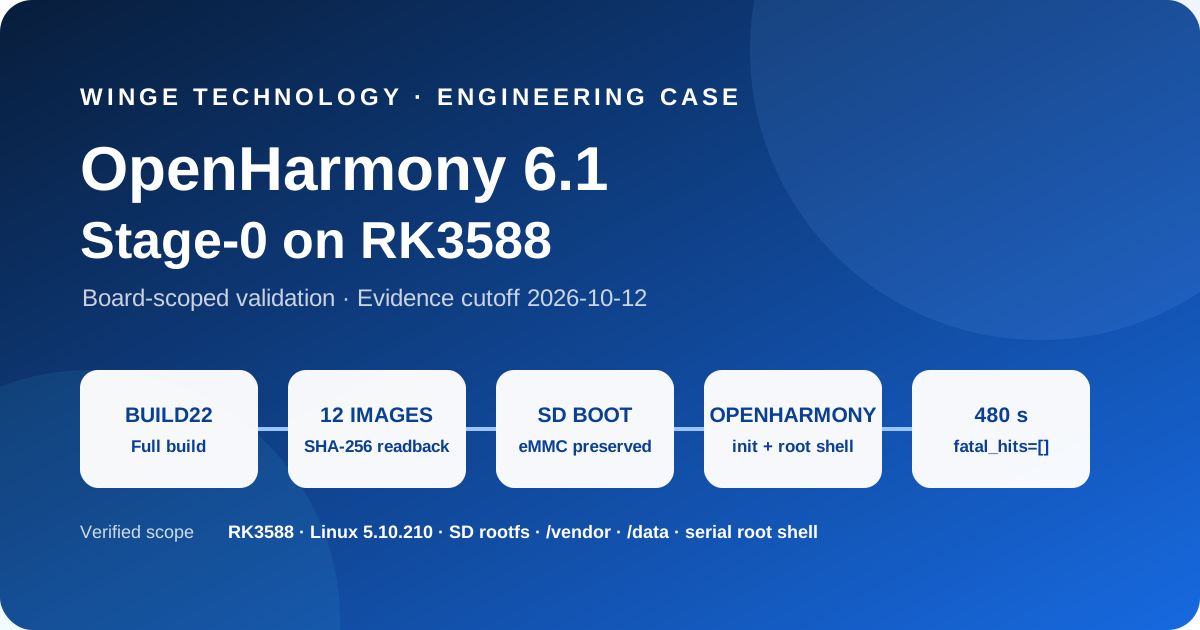
Under this project's defined conditions, OpenHarmony 6.1 booted the RK3588 kernel and OpenHarmony init from SD, mounted the system partitions, and provided a serial root shell. The conclusion applies only to this board, the Build22 image, SD boot media, and the headless Stage-0 scope.
PROJECT SCOPE
This was not a copy of an off-the-shelf image. The work aligned the RK3588 board profile, boot assets, partition table, driver interfaces, storage-controller paths, and system-service dependencies.
Pinned OpenHarmony-v6.1-Release, the RK3588 AArch64 target, Linux 5.10.210, the EVB1 LP4 V10 DTB, and SHA-256 values for critical boot assets.
Checked device identity, media type, capacity, CID, mounts, partition limits, and GUIDs before writing; the onboard eMMC retained the Android maintenance environment.
Added missing RK3588 clock-link entries and lookup guards; returned an error when CSI2 had no MMIO resource instead of dereferencing a null resource.
Moved fstab, updater, init, and extlinux references from the eMMC controller path to the SD controller used in this run.
Adjusted failure propagation for foundation and render_service so accountmgr was not terminated as a cascade and the system passed the former 332-second failure point.
Build22 met the project's minimum headless Stage-0 criteria. Every value below is scoped to this board and image.
ENGINEERING PATH
Under this project's defined conditions, OpenHarmony 6.1 booted the RK3588 kernel and OpenHarmony init from SD, mounted the system partitions, and provided a serial root shell. The conclusion applies only to this board, the Build22 image, SD boot media, and the headless Stage-0 scope.
VERIFIED EVIDENCE
Build22 met the project's minimum headless Stage-0 criteria. Every value below is scoped to this board and image.
TECHNICAL BASELINE
EVIDENCE BOUNDARY
Build22 met the project's minimum headless Stage-0 criteria. Every value below is scoped to this board and image.
The 480 seconds are the serial capture window, not a claim of long-term stability, graphics readiness, complete peripheral support, or production reliability. Display, GPU, touch, audio, networking, USB/HDC, cameras, suspend/resume, and full reboot cycles are outside this stage.
Patch 0027 passed source applicability checks, a full Build23 build, and static image inspection. Build23 evidence covers build and static inspection only, not an on-board regression, so this page does not claim an on-device foundation fix.
FAULT ISOLATION
FaultLogger traces located the direct Build22 foundation fault in the SELinux restorecon path during AppDomainVerifyMgrService initialization; getenforce returned Disabled on the board.
Patch 0027 passed source applicability checks, a full Build23 build, and static image inspection. Build23 evidence covers build and static inspection only, not an on-board regression, so this page does not claim an on-device foundation fix.
FAQ
No. The result is limited to the specified board, image, boot media, and test conditions.
SD preserves the Android maintenance environment on eMMC, while media identification and readback checks reduce wrong-target risk.
No. It only shows that monitored kernel panic, Oops, and critical-service fatal events did not occur during this Build22 capture window.
The direct path was located and Build23 passed build and static checks, but there is no Build23 on-board regression evidence in this publication.
Board model and revision, source tag, vendor BSP or boot assets, device tree, boot media, serial access, peripheral list, existing logs, and acceptance criteria.
APPLICATIONS
OpenHarmony source builds and boot adaptation for RK3588 boards
Board-level BSP migration for the OpenHarmony standard system
U-Boot, extlinux, GPT, and partition-image debugging
Device-tree and Linux 5.10 driver compatibility
Safe SD/eMMC dual-media boot validation
System-service, FaultLogger, and native crash-stack analysis
DIRECT CONTACT
Share the board model, hardware revision, source or BSP, boot assets, serial logs, peripheral list, and acceptance criteria. Phone, email, WeChat, and WhatsApp are available directly on this page.
 WeChatQR code shown here
 Online

 Phone
Phone

 WeChat




 Top
Top